Four Down
Four cards face down. You are shown two of them, once. Lowest total wins — if you can remember what you are holding.
2–4 players
The rules, in full
Setup
An ordinary 52-card pack, and two, three or four players. Everyone gets four cards, dealt face down and laid out in a row in front of them. Nobody may pick them up and nobody may look along the row.
Before the first turn you are shown the two nearest cards in your own row — once. They go back face down and they stay that way. Everything you know after that moment you either worked out or remembered, which is the whole game.
The next card off the pack is turned face up to start the discard pile, and what is left becomes the stock. That face-up card matters more than it looks: it is what makes the very first turn a decision rather than a formality.
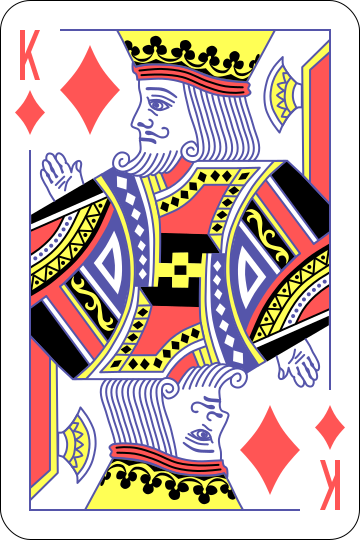
Card values are what you are trying to keep small. Ace counts 1 and the numbers count their face value, a jack is 11 and a queen is 12, and a king is 13 — except the king of diamonds, which is worth nothing at all and is the best card in the pack.
This is the four-card Golf family, played across the world under names like Cambio, Cabo, Pablo and Cactus, with the rules differing from town to town. Ours follows the Cabo line, and every place where a source left something open is spelled out on this page rather than left for you to discover mid-game.
How to play
On your turn you take exactly one card, and you choose where from: the face-down stock, or the face-up top of the discard pile.
A card taken from the DISCARD pile has to be used. Put it into your row in place of one of your four, and the card it replaces goes face up onto the pile for everybody to see. You may not take it and then change your mind — that is what stops a player cycling the same card to burn turns.
A card taken from the STOCK is yours to look at first, and then you have four choices: put it into your row in place of one of yours, throw it away face up, use its power if it has one, or gamble it on a match.
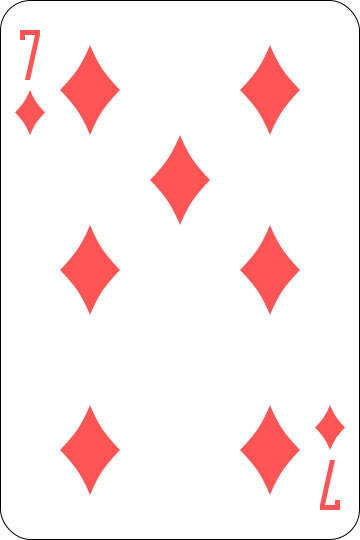
The powers, and they only work on a card that came off the stock. A 7 or an 8 lets you look at one of your OWN cards. A 9 or a 10 lets you look at one card belonging to somebody else. A jack or a queen swaps any two cards on the table — yours, theirs, or one of each — without either of you seeing what moved.
A MATCH is the gamble. Point at any face-down card on the table that you believe is the same rank as the one you just drew. If you are right, both cards go onto the pile and that slot is simply empty from then on, which is worth nothing at all at the end of the round.
Match one of your OWN cards and you are a card lighter. Match somebody ELSE'S and you have to fill the hole you made from your own row, face down and without looking — so the move hands a card over rather than merely getting rid of one. That is the only way to make somebody else's problem out of your worst card.
Get it wrong and it costs. The card you pointed at is turned face up in front of everybody, so the whole table now knows it, it goes straight back where it was, and you take a penalty card off the stock into your own row without looking at it.
All four kings match each other, the king of diamonds included — which is worth knowing, because it means a worthless card can take a 13 off the table.
When you think you are holding the lowest total, CALL instead of drawing. You do nothing else that turn, everybody else takes exactly one more, and then every row is turned face up and counted.
Controls
Tap the stock or the discard pile to take a card. What you drew is shown to you and to nobody else — the other players can see that you took a card, and from where, and nothing more.
Once a card is in your hand the buttons for what you can do with it appear along the bottom. The power button is only there when the card actually has a power, so you never have to remember which ranks do what.
To put the card into your row, tap the slot you want to replace. To throw it away, tap Discard.
To use a look-at-a-card power, tap the card you want to see. To use a jack or a queen, tap the two cards you want to swap, in either order.
To match, tap Match and then tap the face-down card you are claiming. There is no confirmation step, because hesitating over it in front of three other people tells them as much as being wrong does.
A card you are shown — your opening two, or anything a power reveals — appears for a few seconds and then turns back over. Nothing keeps it on the screen for you, and there is no way to look again.
The Call button sits beside the stock and is available on your turn before you draw. Once you have taken a card it is too late for this round.
This is not a pass-the-phone game. What each player knows is private, so everybody needs their own device.
Scoring
At the end of a round every row is turned face up and each player adds up what is still in front of them. An empty slot counts nothing, so a card matched away is a card that can never score against you.
That total is added to your running score, and then the next round is dealt. Scores only ever go up, so a good round is a small one and a perfect round is nought.
The match ends the moment anybody's running total reaches 100. Reaching it does not win — it stops the game, and whoever has collected the least by then has won.
Winning a match is worth 22 points towards your level, a draw is worth 8, and a loss still pays 3, on the same principle every game here follows: finishing a match is worth something even when you lose it.
That prices it with Carrom and Corner Claim rather than with the short abstracts, because a match runs about ten rounds — measured in self-play, not guessed at.
Four Down is RATED at two players. A two-handed match moves the same ranked ladder as Chess and Dama; three- and four-handed games award points and stats and leave the ladder alone, as every game here that seats more than two does.
Winning five matches earns this game's badge, as every title here has one.
Winning
The lowest total when the match ends takes it. Not the highest, and not the player who crossed 100 — crossing it is what ends the game, not what wins it.
A round can end three ways. Somebody calls and everybody else gets one last turn; somebody matches away the last card in their row — usually their fourth, more if a failed match has added a penalty card, which ends it on the spot; or the stock runs out.
Calling carries no bonus and no penalty in this line of the game. The price of calling badly is that you have just handed every opponent a free turn to put their worst card into your row, and that is a real price.
If two or more players finish level on the lowest total, the match is a draw between exactly those players and nobody else.
Tips
Learn your two opening cards properly before the first turn ends. Everything else in the game is built on knowing those two, and players who skim them spend the whole round guessing at half their own row.
The king of diamonds is worth nothing and looks exactly like the worst card in the pack. If one comes to you, keep it, and remember that all four kings match each other — drawing any king lets you throw a 13 off the table.
Matching your own card is almost always better than replacing it. Replacing trades a big number for a smaller one; matching removes the slot altogether and no future card can ever land in it.
Do not call the moment your total looks respectable. Everybody gets one more turn after you, and a jack or a queen in somebody's hand is enough to put a 13 where your 2 was. In self-play the caller turns out to be lowest about seven times in ten, which is exactly how often it should be.
Watch which cards other players look at, and watch what they do straight afterwards. A player who peeks at their own card and then immediately replaces it has told you the card was bad; one who peeks and leaves it alone has told you the opposite.
A wrong match is not just a penalty card — it shows the whole table a card they did not know. If you are not fairly sure, take the smaller loss and put the card into your row instead.