Basra
Catch cards off the table by matching a rank or making a sum — and clear the whole floor in one card for the bonus the game is named after.
2 or 4 players
The rules, in full
Setup
A standard 52-card deck, nothing removed. Two players is the canonical Egyptian game and the one every rule below is written for. Four players is offered as the PARTNERSHIP variant — you and the person facing you share one pile of captured cards and one score, and every rule, including the 27-card majority, then counts for the pair rather than the person. Three is not offered: the majority award is "27 of 52", a two-sided figure no source explains at three seats.
Four cards to each player, then four face up in the middle. That middle is called the floor, and it is where the whole game happens.
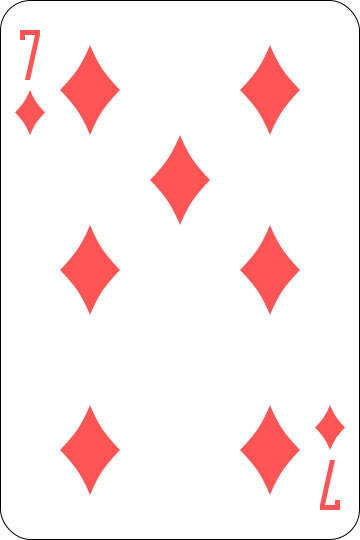
If a Jack or the seven of diamonds turns up in that opening four, it is buried back in the deck and replaced. Both of them sweep the entire floor, so either one lying there before anybody has played would be a free gift to whoever goes first.
Who deals is drawn at random and rotates each round, and the player to the dealer's right leads. Your own hand is dealt on our servers and never leaves them — the other players' cards are not on your phone in any form.
How to play
On your turn you play exactly one card face up. It takes whatever it can from the floor; if it takes nothing, it stays there and becomes part of the floor itself. There is no passing.
MATCHING A RANK: your card takes every card on the floor of the same rank, not just one. Two kings lying there both go to a king.
MAKING A SUM: a number card also takes any group of number cards adding up to its value. An ace counts as one and never eleven. Jacks, queens and kings have no numeric value at all, so no sum ever reaches them — a queen is taken by a queen and by nothing else.
You can do both in the same play. With 4, 6, 10 and 3 on the floor, a ten takes the ten AND the four and six together.
THE JACK sweeps the entire floor, whatever is on it, including the courts. Played to an empty floor it takes nothing and simply lies there, to be picked up later by another Jack or by the seven of diamonds.
You are never forced to play a card that captures. Putting one down deliberately — to leave a single card you can take next turn, or to avoid giving something away — is a real and normal part of the game.
Controls
Your hand is fanned along the bottom of the screen. Tap a card to pick it up; it lifts clear of the others and the cards it would take are highlighted on the floor before you commit to anything.
Tap it a second time, or tap the floor, to play it. Nothing is sent until then, so you can pick each card up in turn and see exactly what it catches — which is the fastest way to learn the sums.
A card that takes nothing is still legal, and the app will let you play it. It shows you the empty catch first so a discard is always deliberate rather than a mistake.
Your opponents' hands are shown as face-down backs with a count. You never see their cards, and neither does your phone: the hands are hidden on our servers, not merely covered up on your screen.
The banner above the floor tells you what is live right now — how many cards are left to deal, and whether the majority is carrying over from a tied round.
The floor does not mirror in Arabic. Cards lie where they were played, in the same order for both players in both languages.
Scoring
A round is scored when the deck runs out and every hand is empty. Whatever is still on the floor goes to whoever made the last capture — that is not a basra and earns no bonus.
MOST CARDS is worth 30 points, and it needs 27 of the 52 — a real majority rather than an arbitrary threshold. It is by far the biggest thing on the table, and it is why a card that scores nothing is still worth taking.
If the cards split 26 to 26 the 30 points go to nobody and CARRY: the next round's majority is worth 60, then 90, and it keeps compounding until somebody takes it.
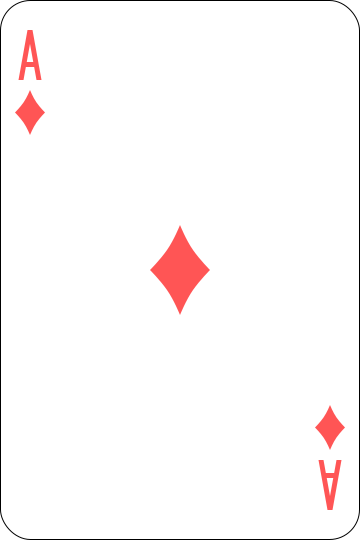
Each ace is 1 point and each Jack is 1 point, so 8 points are spread across those eight cards. The two of clubs is worth 2, and the ten of diamonds is worth 3. Nothing else scores. A whole round is 43 points plus 10 for every basra.
A BASRA is clearing the entire floor with a single card, and it is worth 10. Clearing a floor of exactly one card counts — that is the original case the game is named for.
Two exceptions worth learning, because they are the ones that surprise people. A JACK clearing the floor is NEVER a basra, however clean the sweep. And the SEVEN OF DIAMONDS sweeps the floor like a Jack, but it only earns the basra when the floor is all number cards adding up to ten or less.
On your profile a win pays 24 points, a draw 8 and a loss 3 — priced with Domino's match rather than with the short games, because a match to 121 is a long sitting. Basra is rated and moves the same ladder as chess, in an online match between exactly two people.
Winning
The match runs to 121 points across as many rounds as it takes — usually three to six. Only the MATCH is a result: winning a round banks its points and deals again, and nothing reaches your profile or the leaderboard until somebody reaches the target.
In a partnership the two of you share one pile and one score, so your partner's captures are your captures and the 27-card majority is the pair's total.
If both sides cross 121 in the same round and are exactly level, another round is played rather than the match being settled on a coin toss.
Leaving the match forfeits it. At four seats that costs your partner too: their side loses and the other pair both take the win.
Practice games against the bot score nothing. A turn left unplayed for two minutes is forfeited to the other side in a two-player match; at four seats it plays itself instead — the card an easy bot would choose — and the match goes on, so your partner never loses for your slow turn.
Tips
Take the majority seriously. Thirty points dwarfs everything else on the table, so a fat catch of worthless cards usually beats a thin catch of scoring ones.
Hold your Jack. It sweeps whatever is there, so it is worth far more played against a loaded floor than spent on one card — and it is the answer to an opponent who has built the floor up.
Count the tens. The ten of diamonds is the single most valuable card at 3 points, and the two of clubs is next; both are worth taking a worse catch for.
Leaving one card is dangerous. Any matching card, any sum, and the seven of diamonds all clear it for a basra, so a lone card on the floor is an offer rather than a safe discard.
The sums are where the game is won. A five takes an ace and a four, or a two and a three — and if all four are lying there it takes every one of them and clears the floor.
Watch what has gone. Four aces, four Jacks, one two of clubs and one ten of diamonds is the whole scoring pack; once they are taken, only the majority is left to play for.